Welcome to KDE’s Annual Report 2025

By Aleix Pol

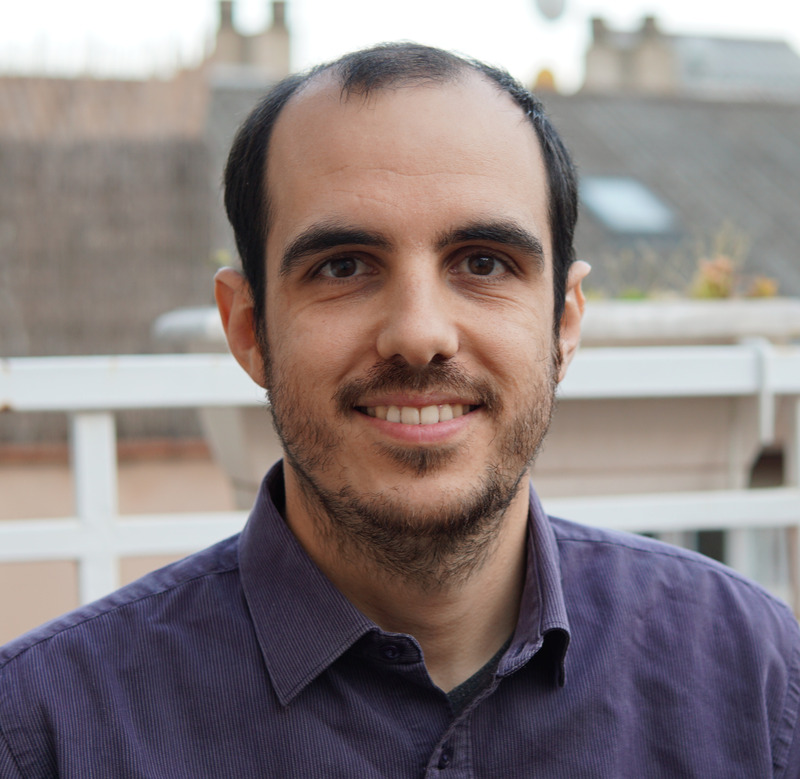
Picture of Aleix Pol

The year 2025 closes KDE's third decade with a great sense of pride. We see our products adopted throughout the world; be it in massive deployments, or by individuals who decided to adopt our software both on their new devices and the older ones where manufacturers gave up on them.

Yet we remain hungry. Our community thrives not only on refining our current solutions but also on finding ways to better reach people and deliver them our products like we have never been able to do before. And we do all of that under Open Source licences, made with open source software by our community of people who care.

As we enter the year of our thirtieth anniversary, we do so with a clear responsibility to continue our work, to continue our mission to understand our users and deliver them honest systems to build and grow with us.

Supported Activities – Developer Sprints and Conferences

Akademy 2025 - KDE at a Turning Point

By Aniqa Khokhar

Akademy 2025 took place in Berlin, Germany, bringing the global KDE community together for a week of talks, Birds of a Feather sessions, workshops, planning meetings and social events. As always, the program blended technical depth, community collaboration and reflections on Free and Open Source Software.

The program included two keynotes. The first focused on digital sovereignty and how Free Software can give public administrations more control over their infrastructure. The other explored how KDE can become more diverse through gentle enforcement, by establishing communication patterns, governance models and accountability mechanisms that help communities grow in more just and inclusive directions.

Across the two main talk days, there was a range of content covering both technical subjects and community priorities. Several talks explored improvements in KDE technologies, including energy measurement tooling for CI systems, updates to design goals and ongoing work on KDE Linux.

Technical sessions also included discussions about language bindings for Qt beyond C++, advances in styling systems for applications, static analysis tools for C++ and Qt, and how to integrate tools like CppCheck into KDE’s continuous integration workflows.

There were also sessions focused on developer experience and infrastructure, such as reports from KDE e.V., a recap of the community’s goals from the past year, and advice on building contributor teams and recruiting maintainers.

Alongside the technical content, talks looked at communication, inclusion and community health. Presentations addressed soft power and inclusive governance, handling negative feedback and personal experiences of bias and harassment in open source work.

There were also practical sessions on application topics, from Flatpak development workflows and emergency and weather alerts in free software systems to strategies for large migrations from Windows to Linux environments.

Lightning talks offered short and focused insights on a range of topics as diverse as future Qt certification, password safety app redesign, KDE Connect use cases and static code analysis workflows.

The weekend concluded with sponsor talks, community awards recognising long-standing contributors and plenty of informal discussions in the social program.

Overall, Akademy 2025 combined practical technology progress with community discussion and introspection in a way that reflected KDE’s long-standing culture of openness and collaboration.

Images from Akademy 2025
Images from talks, speakers and attendees at Akademy.

Events with KDE Representation

By Aniqa Khokhar

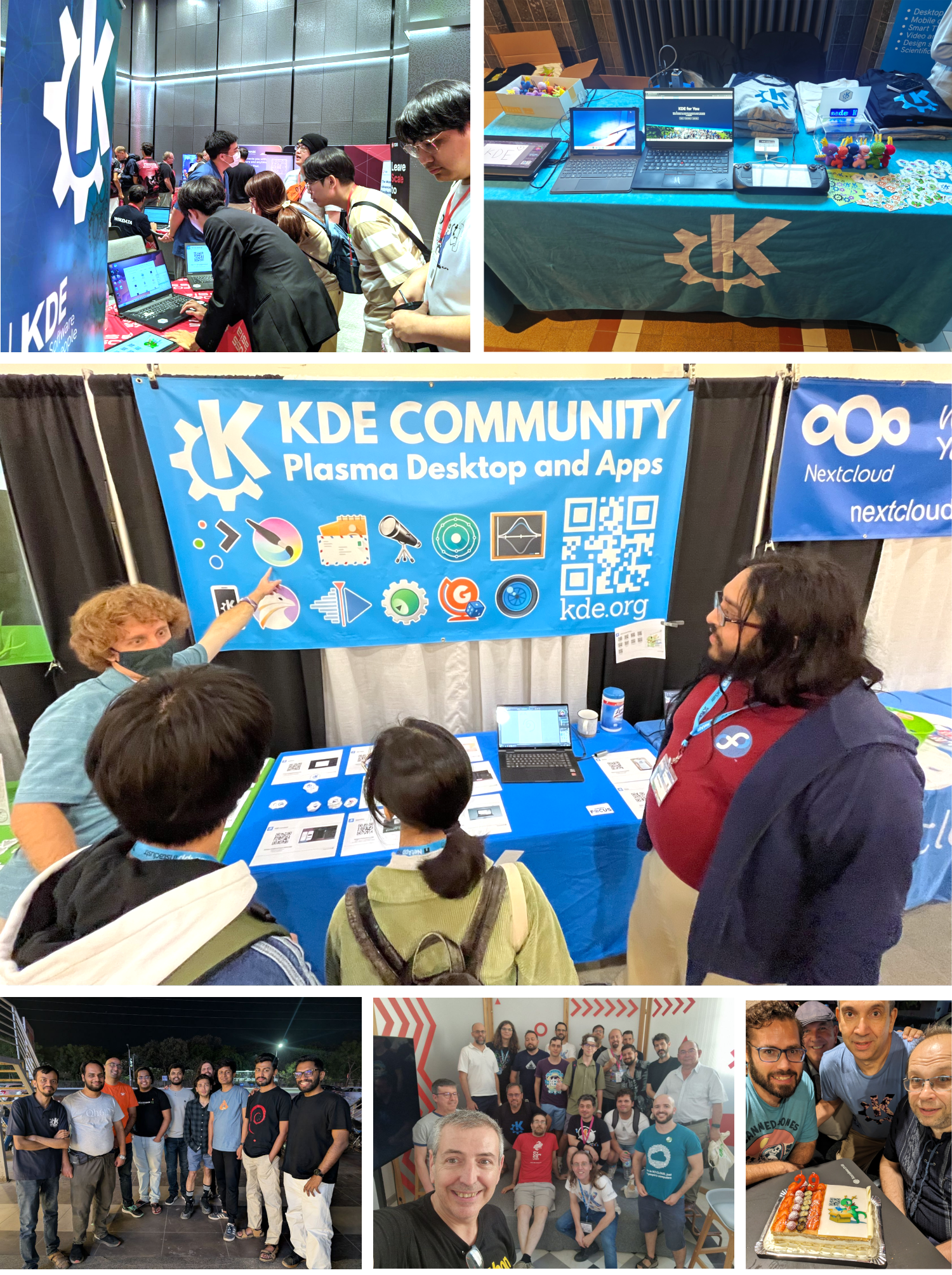
During 2025, KDE was represented at numerous events worldwide, engaging with the community, showcasing the latest developments, and advocating for free and open-source software (FOSS). KDE representatives participated in a variety of FOSS and non-FOSS events, setting up stalls, hosting booths, delivering talks, and networking throughout the year, including:

Images from KDE events around the world
From left to right and top to bottom: FOSSASIA, FOSDEM, SCaLE, con.kde.in, Akademy-es, 29th Anniversary party.

KDE Sprints

By Aniqa Khokhar

This year, KDE organized numerous sprints and events worldwide, engaging with the community to stimulate productive high-bandwidth collaboration and community building. The goal of these events was to use face-to-face time to get work done in the most efficient way and catalyze longer-term development efforts.

KDE sprints and events form an essential part of the culture of KDE as they are an integral part of the development process, and foster communication, collaboration, coordination, and forward planning. This year’s sprints and events included:

Images from KDE sprints from around the world
From top to bottom and left to right: Plasma sprint, input mini-sprint, PIM sprint, and Kdenlive meetup.

2025 Highlights

OS Award

By Aniqa Khokhar

Lydia Pintscher, Vice President of KDE e.V., received the European Open Source Award for Advocacy and Awareness. She received the Award for her significant contribution to the development of the open knowledge graph Wikidata.

Open source initiatives support democracy, innovation and digital independence. The European Open Source Award is being presented by the European Open Source Academy for the first time in 2025.

A picture of Lydia at the ceremony with the award
Lydia Pintscher receives the 2025 OS Award for Advocacy and Awareness

Going all-in on a Wayland future

By The Plasma Team

Plasma entered a new era in 2025: after nearly three decades of KDE desktop environments running on X11, the future KDE Plasma 6.8 release was to become Wayland-exclusive! Support for X11 applications will be fully entrusted to Xwayland, and the Plasma X11 session will no longer be included.

For most users, this will have no immediate impact. The vast majority of our users are already using the Wayland session, it’s the default on most distributions, and some of them have already dropped — or are planning to drop — the Plasma X11 session independently of what we decide.

In the longer term, this change opens up new opportunities for features, optimizations, and speed of development.

Because we’re certain that many people will have questions about this change, the Plasma team has prepared the following FAQ:

Plasma 6.8 means the X11 session will be supported by KDE until…?

The Plasma X11 session will be supported by KDE into early 2027.

We cannot provide a specific date, as we’re exploring the possibility of shipping some extra bug-fix releases for Plasma 6.7. The exact timing of the last one will only be known when we get closer to its actual release, which we expect will be sometime in early 2027.

What if I still really need X11?

This is a perfect use case for long term support (LTS) distributions shipping older versions of Plasma. For example, AlmaLinux 9 includes the Plasma X11 session and will be supported until sometime in 2032.

Will X11 applications still work?

Outside of rare special cases, yes, they will still work using the Xwayland compatibility layer. It does a great job of providing compatibility for most X11 applications, and we provide several additional compatibility features on top, namely improved support for fractional scaling and (opt-in) backwards compatibility with X11 global shortcuts and input emulation.

In certain cases, 3rd-party applications doing specialized tasks like taking screenshots or screencasting need to be adjusted to work as expected on Wayland. Most have already done so, and the remaining ones are making progress all the time.

Does X11 forwarding still work?

Yes, Xwayland supports it. Waypipe exists for similar functionality in Wayland native applications as well.

Can I still run KDE applications on X11 in another desktop environment?

Yes. There are currently no plans to drop X11 support in KDE applications outside of Plasma.

This change only concerns Plasma’s X11 login session, which is what’s going away.

What about gaming?

Games run better than ever on the Wayland session! Adaptive sync, optional tearing, and high-refresh-rate multi-monitor setups are all supported out of the box. HDR gaming works with some additional setup, too!

What about NVIDIA GPUs?

While Wayland support in the proprietary NVIDIA driver was quite rocky a few years ago, it has matured tremendously. Graphics cards still supported by the manufacturer work just fine nowadays, and for very old NVIDIA GPUs, the open source Nouveau driver can be used instead.

What about accessibility?

Accessibility is a very broad topic, so it’s hard to make any definite statements, but we’re generally on par with the X11 session. All the basics already work as expected, including screen readers, sticky & bounce keys, zooming in, and so on.

Some things are better, like touchpad gestures for adjusting the zoom level, and applying systemwide color filters to correct for colorblindness. And even more improvements are expected by the time Plasma 6.8 rolls around.

However, accessibility features provided by third-party applications may be worse in some aspects. Please open a bug report if you have any special requirements that we don’t cover yet! This is an active topic we’re very interested in improving.

What about automation?

Many tools can be used for automation in the Wayland session; for example wl-copy/wl-paste, ydotool, kdotool, kscreen-doctor, and the plasma-apply-* tools. Generally Plasma is extensible enough that you can add what’s still missing yourself, for example through KWin scripts or plugins.

What about the Significant Known Issues?

While we can’t promise all problems will be completely gone (some depend on application support), we’re actively working on addressing the last stragglers on that Wiki page.

Some of them are really close to being fixed; for example, the issues around output mirroring will be gone in Plasma 6.6. Session restore and remembering window positions are also being actively worked on.

What about Plasma on the BSDs?

FreeBSD is already shipping a working Wayland session, so there should be no upstream problems on that front. If there are any remaining issues we can help with upstream, please reach out to us!

What about the kwin_wayland and kwin_x11 split?

In Plasma 6.4, we split KWin into separate X11 and Wayland versions. This allowed KWin to go all-in on Wayland earlier, without being held up so much with legacy support for X11. For users with remaining edge-case requirements for X11, we put in the extra effort to keep X11 support for the rest of the desktop since then.

While the split helped a lot, KWin is only one piece of the puzzle. The Plasma desktop as a whole has many places where development is held back by the need to support the lowest common denominator of the two window systems.

The bottom line

We believe that eventually dropping the Plasma X11 session will allow us to move faster to improve stability and functionality for the majority of our users — who are already using Wayland.

If we want to keep producing the best free desktop out there, we have to be nimble enough to adapt to a rapidly changing environment with many opportunities, without the need to drag forward legacy support that holds back a great deal of work.

The Wayland transition has been long, and at times painful. But we’re very close to the finish line. Passing it will unlock a lot of positive changes over the next few years that we think folks are going to appreciate!

Plasma Mobile Grant

By Aniqa Khokhar

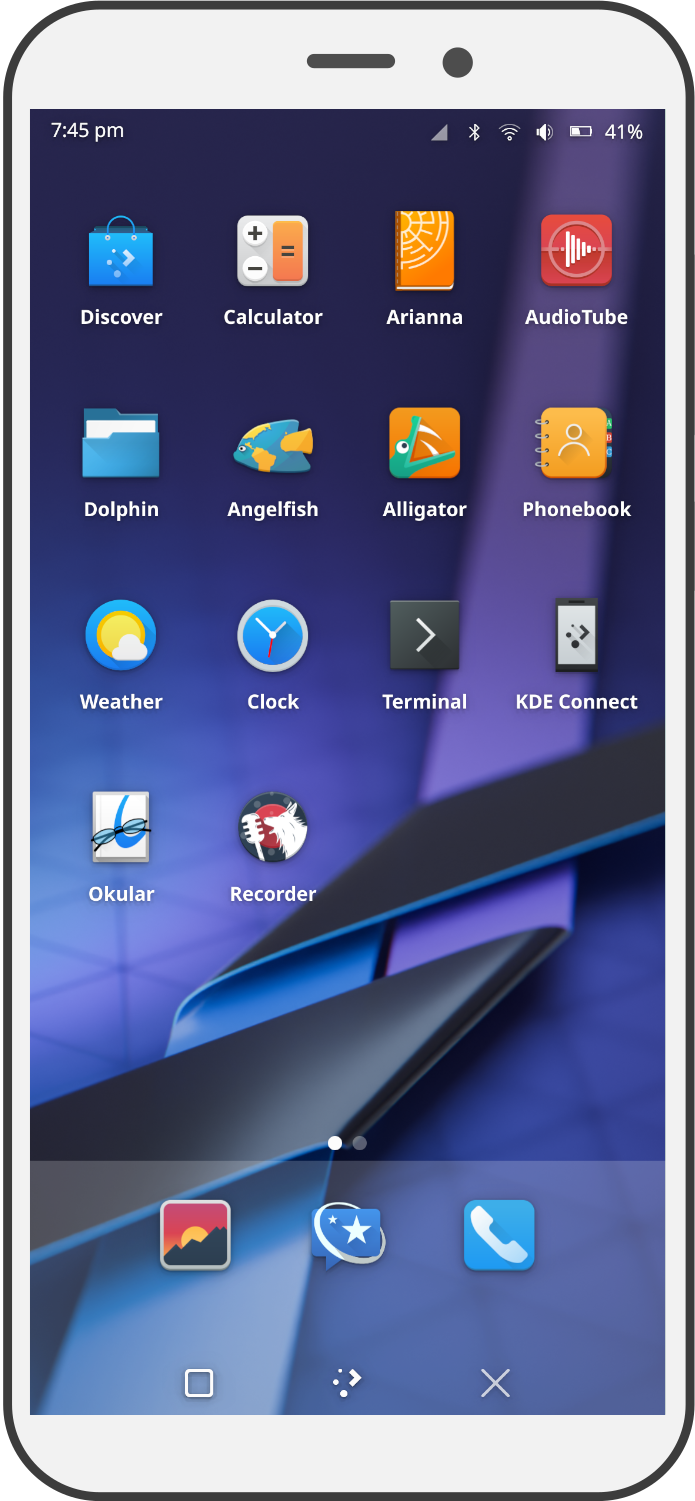
Plasma Mobile running on a Samsung phone

Plasma Mobile received funding support through the NGI0 Core Fund, established by NLnet with financial backing from the European Commission’s Next Generation Internet.

This funding supported improvements to power management in Plasma Mobile, KDE’s open source user interface for mobile devices. Plasma Mobile runs on free and open source operating systems such as Linux and brings the flexibility and customisation of Plasma Desktop into a mobile form factor.

For free software mobile platforms to reach broader adoption, delivering a strong day-to-day user experience is essential. Battery life plays a crucial role in that experience. This project focuses on improving power efficiency across Plasma Mobile, helping devices run longer on a single charge while maintaining a smooth and responsive user experience.

Projects, Products and Apps

KRetro

By Aniqa Khokhar

KRetro running on a phone

The first release of KRetro came out in 2025. KRetro is a Libretro frontend written in Qt/Kirigami, designed for Plasma Desktop, Mobile, and Bigscreen.

It allows you to play games for retro consoles by supplying a ROM and Libretro core.

Plasma powered desktop machine and VR goggles from Valve

By Aniqa Khokhar

Valve announced a new Steam Machine desktop PC and Steam Frame VR headset, both powered by SteamOS using KDE’s Plasma desktop.

The Steam Machine is a compact Linux PC designed for living-room gaming while still offering a full desktop experience.

Steam Frame extends this approach to virtual reality, combining VR gaming with access to a traditional desktop environment.

Together, these launches highlight Valve’s ongoing commitment to open-source software, Linux-based gaming ecosystems and KDE Plasma.

End Of 10

By Aniqa Khokhar

In 2025, KDE Eco played a leading role in advancing sustainable computing through the End Of 10 campaign. Responding to the end of Windows 10 support in October 2026, the initiative promoted Linux and Free and Open Source Software (FOSS)as environmentally responsible alternatives that extend the lifespan of existing hardware.

Through the Opt Green project from 2024 to 2026, KDE Eco helped build a global support infrastructure for hardware upcycling. The campaign now connects users to 455+ local support places, has facilitated 450+ events, and spans 45+ countries across every continent. These networks provide in-person migration assistance, enabling users to keep functional devices in operation rather than replace them.

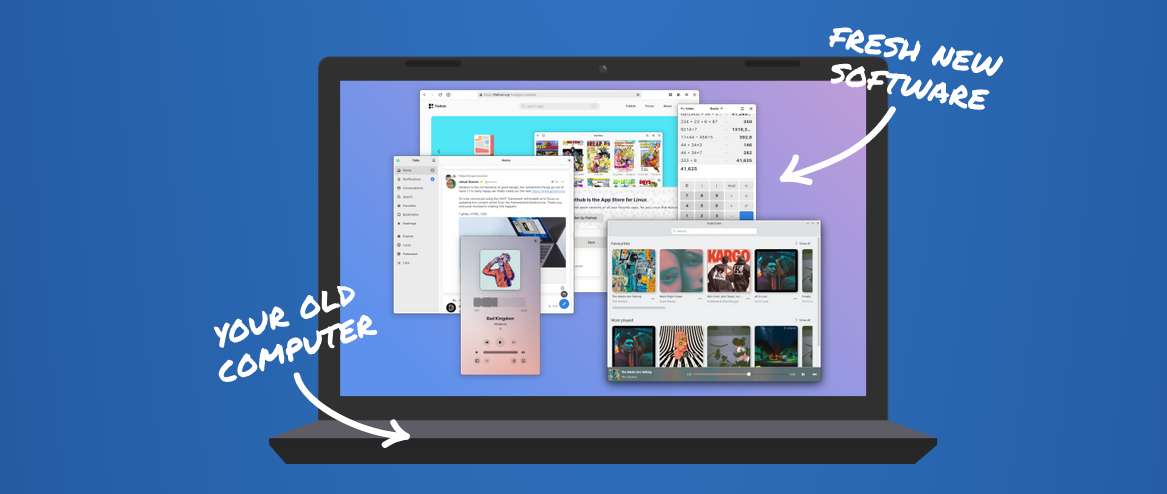
Computer with the words 'Your old computer' and 'Fresh new software' overlaid over it.

A key part of the End Of 10 effort was the KDE for Windows 10 Exiles campaign on the KDE website, which spoke directly to users affected by the end of support for Windows 10. The idea was to keep functional computers in use by switching the operating system rather than discarding or replacing devices. KDE Plasma desktop and related Linux distributions can give new life to older hardware and connect visitors to events and local places that offer hands-on help with installing Linux and learning how to use it. This resource helps lower the barriers to adoption for users who may not be familiar with Linux and reinforces the campaign message that software migration can be both practical and sustainable.

Supported by funding from the German Federal Environment Agency and the Federal Ministry for the Environment, Climate Action, Nature Conservation and Nuclear Safety, this work demonstrated how sustainable software development can deliver measurable environmental impact.

Through End Of 10, KDE for Windows 10 Exiles, and Opt Green, KDE Eco continues to position Free Software as a scalable solution to reducing electronic waste, lowering manufacturing-related emissions, and strengthening digital sovereignty worldwide.

Mentorship Programs

Google Summer of Code

By Carl Schwan

We again participated in Google Summer of Code and we had 12 successful projects.

Akonadi/Merkuro

Merkuro is a modern groupware solution and uses Akonadi as a backend. We had two mentees working on Akonadi, and in particular, on how the resources and their configuration dialogs interact with Merkuro on mobile.

  • Pablo Ariño worked on improving the memory usage of the Akonadi agents and resources. He did that by ensuring the configuration dialogs of the agents are moved to a separate plugin, which is then loaded on demand by the application, instead of having the agents being GUI processes which handle their configuration dialogs directly.
  • Shubham Shinde worked on the UI side of things by writing the infrastructure for config dialogs in QML. This is extremely important to get mobile optimized dialogs on mobile and is also a good occasion to clean the dialog code up. All the major code changes can be found on the following merge requests: Akonadi and KDE PIM Runtime.

Kdenlive

Kdenlive brings you all you need to edit and put together your own movies. We had 1 project for KDE's full-featured video editor:

  • Ajay Chauhan improved the support for timeline markers in Kdenlive. Previously, we only supported single point markers, which can be used to mark a specific point in time. Ajay added support for duration-based markers that define a clear start and end time.

ISO Image Writer

  • Akki Singh worked on a port of ISO Image Writer from QtWidgets to Kirigami. Akki also added a bunch of features to the app, such as allowing you to download ISO images for some of the more popular KDE distributions, or from a URL automatically.
KIOImagWriter showing a button that allows you to choose a Linux image to write.

OSS-Fuzz Integration

OSS-Fuzz is a program by Google that fuzzes our code in search of vulnerabilities.

  • Azhar Momin focused his work on improving the OSS-Fuzz integration in the KDE libraries. Azhar moved our configuration to our repos, making them easier to maintain, and the fuzzer now scans many thumbnail formats (e.g. poppler, syntax highlighted text, krita archives, mobipocket and many more). He also fixed some of the bugs detected by the fuzzer, like a memory leak in the Blender thumbnail extractor.

KDE Linux / Karton

  • Derek Lin worked on Karton, the new virtual machine manager from KDE. He implemented, among other things, keyboard input support, basic SPICE viewer (non hardware accelerated) and audio support.

Since the end of GSoC, he has also added hardware acceleration to the playback, and you can find more information about that on his blog.

Karton's control panel and two virtual machines running simultaneously.

GCompris

GCompris is KDE's educational suite for children learning at home or school. It comes with around 200 activities to learn while having fun. The next iteration of the suite adds a teacher panel to follow the progress of children and provide customized exercises to focus on specific topics.

View of the teacher's conrtrol panel.

Mankala

The Mankala engine is a project that was started during last year's GSoC. The project is still in review and is pending integration into KDE.

  • Srisharan V S worked on a cross platform GUI for MankalaEngine. On the desktop, it is possible to play Mankala games against a remote opponent, provided both players have XMPP accounts. The GUI uses QXmpp for networking. The GUI works on both desktop and mobile, though network play is not yet available on mobile as support for this needs to be re-enabled in the QXmpp library.

Krita

Krita is KDE's free and open source cross-platform application for creating digital art files from scratch.

  • Ross Rosales worked on improving Krita's usability by adding a UI to display common selection actions after selecting a layer. More details on Ross’ journey are available on his blog. The feature request was opened in 2022 and became available in the 5.3 version of Krita.

Cantor

Cantor is a powerful mathematical and statistical computing front-end within the KDE ecosystem. Two contributors worked on improving Cantor this year:

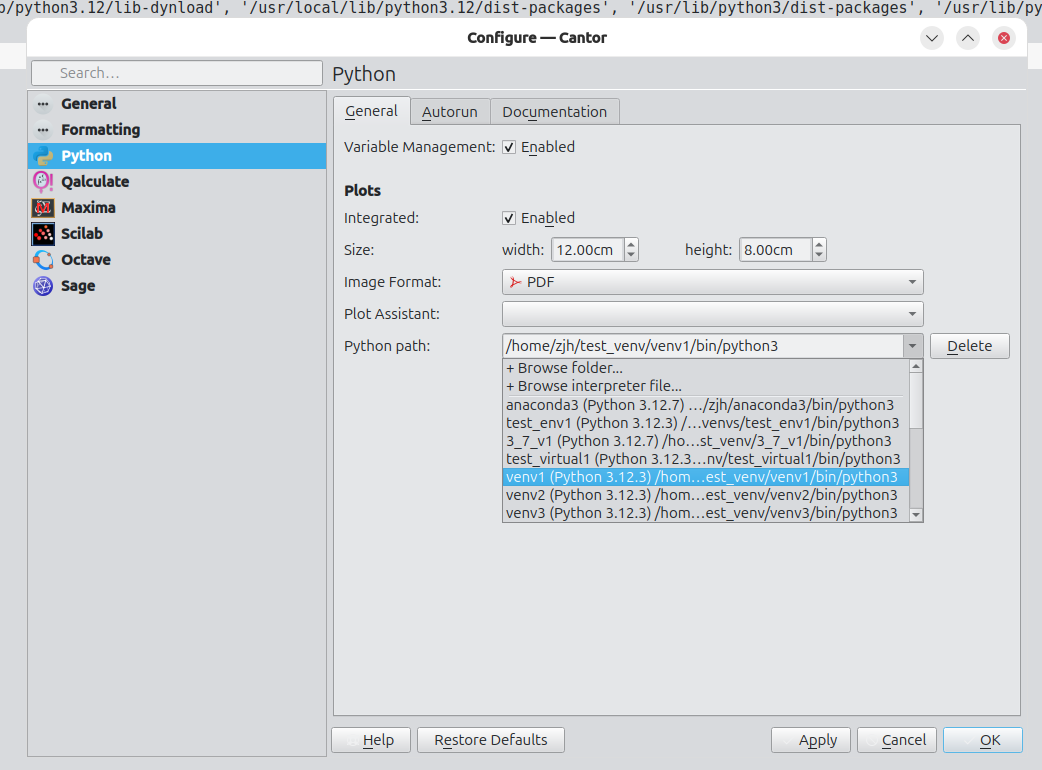
  • ZhengJiahong added features to improve Python support. Merge request allows users to switch Python virtual environments to improve the user experience.
Switching Python virtual environment in Cantor.
  • Lv Haonan worked on integrating KTextEditor into Cantor to replace the custom made spreadsheets. This has several advantages: the current spreadsheets lack some features (auto-indent, code completion, spell checks...), they require extra maintenance from developers, where a better solution already exists within KDE, and the change brings consistency between the different backend editors.
Cantor's integrated text editor'.
Preview of the mentorships landing page

Mentorship Portal

One of the current KDE Goals is to improve the long term sustainability of KDE by recruiting and keeping more newcomers.

  • Anish Tak worked on extending the current mentorship website to make it cleaner and with more information for newcomers.

KWin

KWin is an easy to use and flexible, window manager and compositor for the KDE Plasma desktop. It controls how windows are drawn, moved, and displayed, and handles input (keyboard, mouse, touch, etc.).

Yelsin 'Yorisoft' Sepulveda worked on adding game controller input support to KWin. By using input libraries like libevdev, he was able to add an option in Plasma System Settings that enables awareness of game controllers and detects their input. This was essential for adding features, such as:

  • Mapping Game Controller inputs to Keyboard and Mouse
  • Navigating Plasma Desktop with Game Controllers
  • Preventing Sleep/Suspend when gaming with a controller and leaving the keyboard/mouse idle. This year, we again participated in Google Summer of Code and we had 12 successful projects.
KWin's game controller control panel.

Season of KDE

By Johnny Jazeix and participants

2025 was another successful year for the 10 contributors of Season Of KDE!

Kdenlive

Kdenlive brings you all you need to edit and put together your own movies. We had 1 project for KDE's full-featured video editor:

  • Swastik Patel animated transition previews in Kdenlive by extending the TransitionListWidget with a dual-view system (tree/icon) and creating a custom TransitionIconDelegate for rendering GIF previews. The core functionality is powered by a Python script that leverages MLT to generate standardized preview GIFs by applying transitions between colored clips or custom images. The implementation integrates with Kdenlive's existing asset management system, utilizing QStandardPaths for preview storage and QMovie for GIF playback. The UI updates are triggered through signal connections when frames change, providing real-time preview updates in the transitions panel. This enhancement allows users to visually evaluate transitions before applying them to their projects. All the code changes are in this merge request.

KDE Eco

There were 4 new projects related to the KDE Eco project. KDE Eco helps make KDE software more efficient and environmentally friendly, and more accessible at the same time:

  • Anish Tak worked on a new tool, Win2KDE-Chooser project to help users migrate from Windows to Linux by recommending KDE-based distributions. A questionnaire was designed to understand the user's needs, mapping their responses to distribution parameters, like ease of installation, hardware support, and community backing. Further, a recommendation engine was implemented in the backend to rank distributions according to user preferences and hardware specifications. Overall, a functional MVP was created that suggests suitable KDE-based Linux distributions based on users' needs and hardware capabilities.
  • Oreoluwa Oluwasina built a new GUI for the emulation tool KdeGuiTest formerly known as KdeEcoTest with features that allow users to easily create and run a standard usage scenario script. Button commands that record the actions made by a user have been implemented and they display real time in the action buffer widget. The scripts can be modified in the final script widget to finalize each script before saving it in a text file. A combo box has been implemented to toggle to the run script interface where users can select and run final scripts. Additionally, a "Platform supported" error was encountered and fixed by installing a custom pynput package and other packages like Rust.
  • Roopa Dharshini worked on writing technical documentation for the KEcoLab project. After a detailed exploration on the KEcoLab project, an outline was crafted. This mentorship program taught valuable practical experience in team collaboration and in thinking of approaching various possible solutions to a problem.
  • Shubhanshu Gupta worked on rewriting and restructuring the documentation for KEcoLab to make the project more accessible to newcomers. This included explaining usage scenario scripts—core to KEcoLab’s process—and how they simulate real-world software usage to measure energy consumption. The structure of its repository was mapped out, for a clearer understanding of the project. The experience deepened Shubhanshu appreciation for technical documentation and collaborative development of FOSS communities.

Mankala Engine

The Mankala Engine is one project started during last year's Google Summer of Code to introduce a new game to KDE. During this year SoK, we had a lot of projects to improve this game.

Two new variants were added:

  • Rishav Ray Chaudhury implemented the Kalah game for the Mankala Engine. A greedy move selection algorithm was also added and a script for generating a benchmark report for the available games and algorithms.
  • Srisharan V S integrated the traditional game Pallanguli into the Mankala Engine. After researching regional rule variations and the core game logic was implemented in C++. A package of the engine for Fedora has been created, fixing the reported bugs and ensuring everything worked smoothly. Later, a FOSS meetup was organized at the participants college to showcase KDE apps and help students try out Linux. Finally, the documentation was completed and the codebase polished for future contributions.
  • Shubham Shinde worked on enhancing the Mankala Engine by exploring and implementing new gameplay algorithms like MCTS and Q-learning, comparing them with existing ones like Minimax and MTDF. While MCTS didn’t perform well, Q-learning showed better results after optimization. Review and improvement suggestions were also provided on the Pallanguli variant implementation.
  • Ashutosh Singh worked on creating a GUI for mankala Game. This development was done using Kirigami and qml for creating and designing the GUI. The GUI is functional but was still a work in progress by the end of SoK, with several bugs and missing elements which need to be implemented. The current state of the game can be seen below.
  • Nidhish Chauhan implemented a feature in the engine supporting Player versus Player (PvP) mode, with real-time XMPP-based communication for PvP. The project includes a terminal-based user interface, move tracking, and game state management, along with a man page for documentation.

We would like to congratulate all participants and look forward to their future journey with KDE!

Working Groups

Sysadmin

By Ben Cooksley

2025 was another busy year with many changes continuing to take place to our infrastructure.

The biggest achievement during the year was the transition to VM based CI. Prior to this year, KDE had used a mixture of Docker containers and fixed dedicated virtual machines to provide CI services. This was not only expensive to maintain and expand, with each additional operating system requiring fixed capacity to be deployed, but also limited our ability to support Flatpak and Snap builds of our software.

Transitioning to VM based CI has significantly simplified our continuous integration infrastructure and associated technical debt, while making it easier to scale it out by adding additional hardware nodes which take minimal effort to provision and allowing contributors to run builds in the exact same environment locally. During the year we also deployed our first ARM based build node, which is being used to ensure it is easy to bring KDE software to more devices.

Work has also continued on automating the configuration of our infrastructure, with quite a bit of Ansible setup being prepared. In the coming year we expect to start deploying new systems using this setup.

Stats


Created 2 kde.org mailing-lists: rkward linux-cafe-austausch

Disabled 76 kde.org mailing-lists: cantor-bugs lakademy-attendees purism-contact kxstitch kfm-devel kde-partnership kompare-devel rkward-users kopete-devel kget kde-gardening kde-scm-interest calligra-author snorenotify plasma-bugs ksecretservice-devel konversation-devel cutehmi kde-women konq-bugs trojita kde-linux kde-utils-devel calligra-devel kde-usa kde-br symboleditor rolisteam kde-el kalzium gwenview-devel kde-multimedia kde-buildsystem webkit-devel visual-design k3b elisa kde-telepathy-bugs kde-edu-pt_BR kde-india choqok-devel kde-windows kde-devel-es rkward-devel kdepim-bugs kde-finance-apps kde-speech k16 kdenlive kde-games-bugs kde-nonlinux kde-embedded kwrite-devel kde-bindings kde-latam kde-telepathy kirigami qmlweb kde-mac bugsquad kde-look wikitolearn kde-mexico kde-at kde-print-devel kwin kde-android kdelibs-bugs amarok-bugs-dist unassigned-bugs zanshin-devel kde-italia kde-artists neon-bugs enterprise marble-commits


Created 49 kde.org aliases

Disabled 43 kde.org aliases

Modified 7 kde.org aliases


Created 5 kdemail.net aliases

Modified 1 kdemail.net aliases


Created 25 subversion accounts

Disabled 2 subversion accounts


Financial Working Group

By Eike Hein

KDE e.V. is happy to report that 2025 was another healthy and strong financial year for the organization, with significant improvements in the areas of fundraising and overall income, cost control and the reliability of our forecasting and budgeting tools.

In brief, in the period of 2023-2024 KDE e.V. significantly increased its operational volume to downspend a relatively high financial reserve from large one-time donations. We expanded our mission-related activities, for example by opening additional positions and serving the KDE community's needs in new roles and support for new projects.

Intentionally outspending our annual income for several years came with a new strategic focus on improving our fundraising performance, with the goal to eventually balance our budget again and enable further growth. Actions taken include rolling out new ways to engage donors, improving donation-drive websites and upping the quality of our fundraising campaigns. Alongside this, we also invested in the reliability of our forecasting and budgeting, to closely monitor and actively manage our burn rate during this period.

In 2024, the new fundraising efforts succeeded in a major way, delivering a record annual income of 620,000 EUR for the organization and more than balancing the budget against a 568,000 EUR spend. Despite this, we chose to increase our spending in 2025 moderately to a high-water mark of 595,000 EUR, giving us time to gain additional experience with campaign repeatability, donor retention and other metrics we are now tracking and considering more closely.

Happily, 2025 income proved more than steady, increasing to another record-high of 849,530 EUR. We once again want to take this opportunity to thank all of the organization's donors. Thanks to your enduring contributions, KDE e.V. is in a position to scale again in 2026, working harder to improve and support the KDE community, and to do so with the intelligence afforded by a longer-term planning horizon.

Our spending came in closely to the planned target as well, at 579,744 EUR, again increasing our confidence in our forecasting and budgeting tools and processes.

To safeguard this stability, in 2026 the Financial Working Group will increase its efforts to analyze and report on fundraising metrics and provide data-based recommendations to improve campaigns and donor engagement. One goal is to improve income steadiness across the first three quarters of the year over time, to decrease reliance on Q4 income and the end-of-the-year fundraising campaign. Another is to improve fundraising for our flagship conference Akademy, which unfortunately did not break even in 2025.

Additional work in the new year will include giving better tools and data to teams in the community that manage their own budget, allowing them to take better decisions with faster turnaround times.

We further look ahead to the community's 30th birthday in 2026, including supporting the global celebrations financially, and are optimistic the organization's financial health on this significant will prove its best.

Income (€):

Patrons/Corporates:96,899.72
Supp. members & donations:607,218.60
Akademy:43,836.60
Other events:5,763.53
Other95,811.79
Total Income:849,530.24
    

Expenses (€):

Personnel:-338,172.06
Akademy:-61,344.07
Sprints-9,739.64
Other events:-7,872.74
Infrastructure:-27,434.14
Office:-7,781.88
Taxes and Insurance:-72,767.65
Other:-54,632.06
Total:-579,744.24

Community News

New Members

KDE e.V. welcomed the following new members in 2025:

  • Bart Ribbers
  • Jack Thomas Hill
  • Akseli Lahtinen
  • Carlos Nathaniel De Maine
  • Finley Watson
  • Mirco Miranda
  • Tracey Clark
  • Farid Abdelnour

Partners and Sponsors

Symless Becomes a KDE Supporter

By Paul Brown

Symless started officially helping fund KDE in 2025.

Symless develops Synergy, an open source solution that allows users to share a keyboard, mouse, and clipboard across several computers at the same time, without extra hardware and regardless of whether they are using Linux, Windows, macOS, or a mix of all of the above.

Becoming a Supporting Member of KDE is a natural step for us", stated the Synergy team representative. "Synergy is heavily rooted in open source, and we want to give back to the community that made it possible. By supporting KDE financially and contributing to upstream projects like Deskflow, we’re helping ensure open source software remains sustainable for both enthusiasts and enterprises”.

It’s exciting to see organizations in our ecosystem participate alongside KDE and Plasma in creating next-generation workflows for everyone", says Aleix Pol, president of KDE e.V.. "We’re glad to welcome Symless as a KDE Supporting Member and value their continued commitment to Open Source.

Symless joins the other supporters, KDAB, basysKom, Haute Couture Enioka who help fund free open source software and development through KDE e.V.

Techpaladin joins KDE's patrons

By Paul Brown

Techpaladin became an official KDE patron and contributes to our community's funding in 2025.

Techpaladin is a consultancy firm specialized in advancing the state of the art in KDE software.

Techpaladin was founded by experienced and prominent KDE contributors who develop KDE-based software for such high-profile companies such as Valve and Qt Group.

"KDE is the giant whose shoulders Techpaladin sits upon," said Nate Graham, CEO of Techpaladin, "so we're very happy to support the mission and the foundation that pushes it forward. KDE e.V. helps make what we do possible, so becoming a Patron is the logical next step!"

"We are glad to welcome Techpaladin as our Patron", said Aleix Pol, President of KDE e.V. "Although a young organisation, we are very familiar with much of the team and know they share a lot of the same values as KDE. I look forward to growing KDE and its products together with them — what better way to do so than as a Patron?"

Techpaladin joinrd KDE e.V.'s other patrons: Blue Systems, Canonical, g10 Code, Google, Kubuntu Focus, Mbition, Slimbook, SUSE, The Qt Company and TUXEDO Computers, who support free open source software and KDE development through KDE e.V.

Thoughts from Partners

Rocky Linux is proud to support KDE as a Patron. The popularity of the Rocky Linux KDE spin demonstrated clear demand for a reliable, enterprise-ready KDE desktop experience, and supporting the community that enables it was an easy decision. We've been consistently impressed by the quality and momentum of KDE Plasma, and KDE's commitment to building powerful software that respects user freedom aligns closely with Rocky Linux's own values. Sustainable open source means supporting upstream projects, and we're glad to stand alongside KDE's other patrons in strengthening the ecosystem we all depend on. We're excited to deepen our collaboration with KDE in the years ahead!


Brian Clemens, Co-founder and Vice President, Rocky Enterprise Software Foundation

KDE is part of our daily workflow. We test Synergy and Deskflow on it every day, so we rely on it being stable and well maintained. Supporting KDE is just backing something we use and depend on.


Nick Bolton Founder-CTO/CEO of Synergy/Symless

KDE e.V. Board of Directors

Aleix Pol i Gonzàlez
President

Eike Hein
Treasurer and Vice President

Lydia Pintscher
Vice President

David Redondo
Board Member

Carl Schwan
Board Member

About KDE e.V.

KDE e.V. is a registered non-profit organization that represents the KDE Community in legal and financial matters. The KDE e.V.’s purpose is the promotion and distribution of free desktop software in terms of free software, and the program package “Plasma Desktop Environment” in particular, to promote the free exchange of knowledge and equality of opportunity in accessing software as well as education, science and research.

Report prepared by Aniqa Khokhar and Paul Brown, with help and sections written by Aleix Pol, Joseph P. De Veaugh-Geiss, Nate Graham, Volker Krause, Kevin Ottens, Ben Cooksley, Johnny Jazeix, Carl Schwan, the KDE Eco Team, the GSOC Contributors, the Plasma Team, and the Promo Team at large.

This report is published by KDE e.V., copyright 2026, and licensed under Creative Commons-BY-3.0.